


While driving home last night from the raceway, listening to a Byrd's song, I was reminded that a sidewinder is a snake.
I'm just so used to using that term, way more, for slot racing.
Anyway, was 'sidewinder' a term that was appropriated from the snake world, just for slot racing, or was it already an automotive term?
I'm going to avoid the Google machine and just ask it here.

Origin of the term 'sidewinder'
Started by
MSwiss
, May 29 2019 11:28 AM
37 replies to this topic
#1

MSwiss
-
- Subscriber
-

- 26,223 posts Joined: 16-April 06
Grand Champion Poster
- Gender:Male
Posted 29 May 2019 - 11:28 AM
Mike Swiss
Inventor of the Low CG guide flag 4/20/18
Former IRRA® Components Committee Chairman
Five-time USRA National Champion (two G7, one G27, two G7 Senior)
Two-time G7 World Champion (1988, 1990), eight G7 main appearances
Eight-time G7 King track single lap world record holder
17B West Ogden Ave., Westmont, IL 60559, (708) 203-8003, mikeswiss86@hotmail.com (also my PayPal address)
Note: Send all USPS packages and mail to: 692 Citadel Drive, Westmont, Illinois 60559
#2
Dave Crevie
-

- Full Member
-
- 5,158 posts Joined: 16-February 09
Grand Champion Poster
Posted 29 May 2019 - 12:11 PM
The first time I saw the term was in an old early sixties Hot Rod, Car Craft or Rod and Custom. It was
used to describe an experimental dragster that had the engine mounted sideways. I might still have
that mag, but wouldn't be likely to find it right away. If I come across it, I'll scan the article and post
it here. I do know that by '64 they were already using the term at the west coast slot tracks.
And you are correct about the snake reference. A Sidewinder is a viper seen in most deserts and
got it's name by the way it moves sideways over the sand.
#3
Bill from NH
-

- Full Member
-
- 15,374 posts Joined: 02-August 07
Age scrubs away speed!
- Gender:Male
- Location:New Boston, NH
Posted 29 May 2019 - 12:19 PM
I've seen them on TV, they actually travel sideways rather than in an ahead direction. They form their bodies into a series of tight back & forth squiggles beside their head.
Bill Fernald
I intend to live forever! So far, so good.
I intend to live forever! So far, so good.
#4
mjsh
-

- Full Member
-
- 367 posts Joined: 16-February 06
On The Lead Lap
- Gender:Male
- Location:Pine Mountain, GA
Posted 29 May 2019 - 01:25 PM
Tony Nancy?
Michael Shepard
#5
Bryan Warmack
-

- Subscriber
-
- 4,787 posts Joined: 17-July 07
Posting Leader
- Gender:Male
Posted 29 May 2019 - 01:27 PM
If I remember correctly, SoCal slot racer Gene Hustings raced 1:1 dragsters in the late 50's and early 60's and built some of the first "sidewinder" dragsters being run and this could be where the term came from from in reference to cars. Maybe Philippe would know more.......
- TSR likes this
#6
Tom Katsanis
-

- Subscriber
-
- 376 posts Joined: 26-April 17
On The Lead Lap
- Gender:Male
- Location:Melbourne, Australia
Posted 29 May 2019 - 05:49 PM
I don't know when they were first called sidewinders I thought maybe the 5 cycle spl from 58/59 but Jack Chrisman drove one called the Magwinder in 60/61 here is an article by hotrod on early sidewinder dtagsters.
https://www.google.c...-dragsters/amp/
https://www.google.c...-dragsters/amp/
- Ramcatlarry likes this
#7
Ramcatlarry
-

- Subscriber
-
- 2,966 posts Joined: 08-March 06
Posting Leader
- Gender:Male
- Location:Barrington, IL 60010
Posted 29 May 2019 - 08:04 PM
https://www.facebook...8AS3eKOj7&ifg=1
If you ever were at OSWEGO Drag Raceway in Northern Illinois, you might have seen this one also. Not a sidewinder, but a handful to keep straight. Al owned the "CHIZLER" rails and drove an early one for the first 200MPH run.
- Tom Katsanis likes this
Larry D. Kelley, MA
retired raceway owner... Raceworld/Ramcat Raceways
racing around Chicago-land
Diode/Omni repair specialist
USRA 2023 member # 2322
IRRA,/Sano/R4 veteran, Flat track racer/MFTS
Host 2006 Formula 2000 & ISRA/USA Nats
Great Lakes Slot Car Club (1/32) member
65+ year pin Racing rail/slot cars in America
#8
TSR
-

- Full Member
-
- 42,307 posts Joined: 02-February 06
The Dokktor is IN
- Gender:Male
- Location:Marxifornia
Posted 30 May 2019 - 01:26 PM
Mike, as far as the term used on slot cars, as soon as cars or chassis had motors with a straight cut gear drive, they were called "sidewinder", rather than "inline". I think that it is as old as slot cars themselves...
While most early cars used 90-degree gear drive from 1955 when they were riding a guiding rail, as soon as Pittman came up with their "700 series" motors with built-in gears, they were called "sidewinder". Now, who came up with that... ???
Lost in time I guess.
Philippe de Lespinay
#9
don.siegel
-

- Subscriber
-
- 5,954 posts Joined: 17-February 06
Grand Champion Poster
- Gender:Male
- Location:Paris, France
Posted 30 May 2019 - 01:33 PM
In fact, both of the first two commercially available "1/32" sets, from 1957, Scalextric and VIP, had sidewinder motors! (The German Bub from 1953 did as well, but it was a multi-geartrain type thing - like a lot of the ancestors!).
Will have to dive into Model Maker to see how they described them...
Don
- TSR and MSwiss like this
#10
don.siegel
-
- Subscriber
-
- 5,954 posts Joined: 17-February 06
Grand Champion Poster
- Gender:Male
- Location:Paris, France
Posted 30 May 2019 - 04:05 PM
Just took a quick look and havn't actually found the first - or any - use of the word "sidewinder" for the moment!
An early Model Maker review of the VIP set (Oct. 57) just says "The motor is set across the chassis...". And in a big article on Gears & Transmission in January 1958, Model Maker just talks about worm, contrate, bevel or spur gears. ("The Scalextric cars use direct spur drive").
Looking at the coverage of the first two R&C drag races (October 62 and February 64), no use of "sidewinder" - but the later one already refers to "Magwinders". A couple articles in Car Craft from 1962 (on the same drag meet, plus motors and chassis) refer to "transverse mounting" - generally of the Pittman DC703.
I'm sure that "sidewinder" is used somewhere in this time frame, but haven't found it yet...
Don
#11
MSwiss
-
- Subscriber
-
- 26,223 posts Joined: 16-April 06
Grand Champion Poster
- Gender:Male
Posted 30 May 2019 - 04:17 PM
Thanks for looking, Don.
I said I was going to avoid Google, but here you go;
Definitions of sidewinder
1
n small pale-colored desert rattlesnake of southwestern United States; body moves in an s-shaped curve
Synonyms: Crotalus cerastes, horned rattlesnake Type of: rattler, rattlesnake
pit viper with horny segments at the end of the tail that rattle when shaken
n air-to-air missile with infrared homing device
Type of: missile
a rocket carrying a warhead of conventional or nuclear explosives; may be ballistic or directed by remote control
Talk about slot racing, getting no respect. LOL
But, now I spot this;
Sidewinder (slot car)


From Wikipedia, the free encyclopedia
Jump to navigation Jump to search
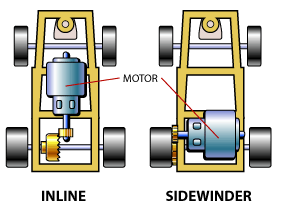
Sidewinder is a type of slot car or motorized model car in which the motor shaft is parallel to the driven axle (usually the rear), and power is transmitted through spur gears or, sometimes, a belt, friction or even by direct drive. The word also refers to the transversely mounted motor of such a car.
A similar type of slot car that has the motor shaft mounted at an angle to the driven axle is the anglewinder. In general, the sidewinder and anglewinder are less common arrangements than the inline motor, in which the shaft is perpendicular to the driven axle and drives it with bevel gears or a pinion and crown gear. Historically, they are also less common than the pancake motor, in which the shaft is vertical, and power is carried to the axle by a chain of gears to a pinion and crown arrangement. Because they require more space between the drive wheels, the sidewinder and anglewinder arrangements are more common in 1:32, and especially 1:24, than in the smaller scales.
The sidewinder and to an extent the anglewinder configurations are often seen as superior for slot racing cars. This is because when accelerating, the reverse torque of the motor transfers weight to the front of the vehicle, and therefore the guide that keeps it on the track. This allows the slot racer to accelerate through corners. There is also a further advantage as, if dynamic braking is used, the reverse torque of the motor then transfers weight to the rear wheels, which invariably are the dominant grip wheels on a slot car. Conversely the reverse torque effect on inline motor configurations transfers weight from side to side and destabilises the car.
Schematic diagrams of common chassis layouts:

Common slot-car motor arrangements

Not so common slot-car motor arrangements
The flat, vertical-shaft pancake motor is seen end-on, with the shaft pointing toward the reader.

These 1914 Lionel slot cars used a direct-drive sidewinder motor[1]
Use of the sidewinder drive goes back to the first commercially available slot cars. Some of Lionel's original slot car models of 1911–1914 used a type of sidewinder drive. Victory Industries used a sidewinder motor in their 1957 VIP line of 1:32 cars. This brand debuted at the same time as the famous Scalextric line and shares with Scalextric the honor of being the first modern manufactured slot-car system.[2]
Mike Swiss
Inventor of the Low CG guide flag 4/20/18
Former IRRA® Components Committee Chairman
Five-time USRA National Champion (two G7, one G27, two G7 Senior)
Two-time G7 World Champion (1988, 1990), eight G7 main appearances
Eight-time G7 King track single lap world record holder
17B West Ogden Ave., Westmont, IL 60559, (708) 203-8003, mikeswiss86@hotmail.com (also my PayPal address)
Note: Send all USPS packages and mail to: 692 Citadel Drive, Westmont, Illinois 60559
#12
TSR
-
- Full Member
-
- 42,307 posts Joined: 02-February 06
The Dokktor is IN
- Gender:Male
- Location:Marxifornia
Posted 30 May 2019 - 05:04 PM
Mike, yes, but none of these companies (Scalextric, VIP etc.) ever use the term. It began in the US, likely as I pointed out, when Pittman began marketing their "700" series of motors designed exclusively for slot car use, with built-in gears. Exactly when and who used it first... ????
Philippe de Lespinay
#13
MSwiss
-
- Subscriber
-
- 26,223 posts Joined: 16-April 06
Grand Champion Poster
- Gender:Male
Posted 30 May 2019 - 05:40 PM
Yes, I realized the above #11 info didn't explain that.
Still interesting for a non-expert, like myself.
- Thom likes this
Mike Swiss
Inventor of the Low CG guide flag 4/20/18
Former IRRA® Components Committee Chairman
Five-time USRA National Champion (two G7, one G27, two G7 Senior)
Two-time G7 World Champion (1988, 1990), eight G7 main appearances
Eight-time G7 King track single lap world record holder
17B West Ogden Ave., Westmont, IL 60559, (708) 203-8003, mikeswiss86@hotmail.com (also my PayPal address)
Note: Send all USPS packages and mail to: 692 Citadel Drive, Westmont, Illinois 60559
#14
hiline2
-

- Full Member
-
- 468 posts Joined: 22-February 06
On The Lead Lap
- Gender:Male
- Location:Piney Woods around Tyler, TX
Posted 31 May 2019 - 06:14 AM
A photo I had in files I found interesting ! Note sure of date but it dates itself well enough.
Attached Images

Paul Bass
#15
Ecurie Martini
-

- Member at Peace
-
- 1,118 posts Joined: 19-February 06
Ecurie Martini
- Gender:Male
- Location:Baltimore MD
Posted 31 May 2019 - 09:24 AM
Mike, yes, but none of these companies (Scalextric, VIP etc.) ever use the term. It began in the US, likely as I pointed out, when Pittman began marketing their "700" series of motors designed exclusively for slot car use, with built-in gears. Exactly when and who used it first... ????
A minor quibble - the Pittman 70X series (the first was a 703) was designed and marketed as a quality replacement motor for the Japanese "can" motor supplied in a line of HO gauge diesel locomotives. The 703 had a nylon spur gear with about a 4:1 ratio and the driven shaft extended about 2" on either side to the center of the power trucks. As I recall, the power was transmitted from the shaft to a pulley on the trucks by a twisted rubber band.
The second version, the 704, had a smaller brass spur, perhaps 3:1. Some of them came with a threaded 1/8" axle. The 705 continued the use of stamped steel field plates but, presumably as a cost cutting scheme, used "broken off" cast magnets instead of the machined magnets of the earlier version. The final iteration, the 706, returned to the machined magnets but used a die-cast frame.
Charlie Pittman was unaware of slot cars before I visited him in Sellersville, Pa in '61 or '62. His first two slot car specific motors were experimental units he sent me for evaluation. They were "in-line" motors with brass axle brackets and stamped contrate gears ( now residing at LASCAM)
EM
- TSR likes this
Alan Schwartz
5/17/36-1/25/24
Requiescat in Pace
5/17/36-1/25/24
Requiescat in Pace
#16
Ecurie Martini
-
- Member at Peace
-
- 1,118 posts Joined: 19-February 06
Ecurie Martini
- Gender:Male
- Location:Baltimore MD
Posted 31 May 2019 - 09:27 AM

Alan Schwartz
5/17/36-1/25/24
Requiescat in Pace
5/17/36-1/25/24
Requiescat in Pace
#17
Ecurie Martini
-
- Member at Peace
-
- 1,118 posts Joined: 19-February 06
Ecurie Martini
- Gender:Male
- Location:Baltimore MD
Posted 31 May 2019 - 09:32 AM
Early DC 703 application:


Merit bodied 1/24 Vanwall
EM
Alan Schwartz
5/17/36-1/25/24
Requiescat in Pace
5/17/36-1/25/24
Requiescat in Pace
#18
Ecurie Martini
-
- Member at Peace
-
- 1,118 posts Joined: 19-February 06
Ecurie Martini
- Gender:Male
- Location:Baltimore MD
Posted 31 May 2019 - 09:36 AM
704 in a 1/32 chassis for a Mercedes 300SLR

ca 1962 - ground clearance measured with a feeler gauge!
EM
Alan Schwartz
5/17/36-1/25/24
Requiescat in Pace
5/17/36-1/25/24
Requiescat in Pace
#19
The Number of
-

- Guest
-
- 1,692 posts Joined: 29-February 08
Checkered Flag in Hand
- Gender:Male
Posted 31 May 2019 - 09:47 AM
It was John Cauthen who used the term first! 🤣🤣😳
- TSR, Rotorranch and Racer36 like this
Bill Fulmer
The lack of any credible evidence is proof the conspiracy is working!
The lack of any credible evidence is proof the conspiracy is working!
#20
TSR
-
- Full Member
-
- 42,307 posts Joined: 02-February 06
The Dokktor is IN
- Gender:Male
- Location:Marxifornia
Posted 31 May 2019 - 10:22 AM
Philippe de Lespinay
#21
Rotorranch
-

- Member at Peace
-
- 1,755 posts Joined: 22-November 10
What's a title?
- Gender:Male
- Location:Atlanta, GA
Posted 31 May 2019 - 10:25 AM
It was John Cauthen who used the term first!

Jeff Chambers
3/14/58-4/20/26
Requiescat in Pace
3/14/58-4/20/26
Requiescat in Pace
#22
TSR
-
- Full Member
-
- 42,307 posts Joined: 02-February 06
The Dokktor is IN
- Gender:Male
- Location:Marxifornia
Posted 31 May 2019 - 11:12 AM
Still interesting for a non-expert, like myself.
Mike, you are an expert, a supreme one at that, just from another era.
A minor quibble - the Pittman 70X series (the first was a 703) was designed and marketed as a quality replacement motor for the Japanese "can" motor supplied in a line of HO gauge diesel locomotives. The 703 had a nylon spur gear with about a 4:1 ratio and the driven shaft extended about 2" on either side to the center of the power trucks. As I recall, the power was transmitted from the shaft to a pulley on the trucks by a twisted rubber band.
Alan, the funny thing about the "703" is that it is effectively a "Sidewinder Inline"... but the smart fellows building slot cars, were quick to cut the shafts' ends and get early 1/8" setscrew wheels mated to the motor.

But this does not tell us, who came up with the moniker, "sidewinder"...
Philippe de Lespinay
#23
Ecurie Martini
-
- Member at Peace
-
- 1,118 posts Joined: 19-February 06
Ecurie Martini
- Gender:Male
- Location:Baltimore MD
Posted 31 May 2019 - 11:18 AM
Correct - and I have no idea where the name came from. BTW, the motor in the photo is a 705 - bright instead of black pole pieces and cast, not machined magnet.
Alan Schwartz
5/17/36-1/25/24
Requiescat in Pace
5/17/36-1/25/24
Requiescat in Pace
#24
TSR
-
- Full Member
-
- 42,307 posts Joined: 02-February 06
The Dokktor is IN
- Gender:Male
- Location:Marxifornia
Posted 31 May 2019 - 11:25 AM
Alan, "same difference"... 
The first production 1/24 scale RTR car had one specifically designed by Pittman for slot car use, first the 704A, then the 706:

But no mention of "sidewinder"...


Philippe de Lespinay
#25
Dave Crevie
-
- Full Member
-
- 5,158 posts Joined: 16-February 09
Grand Champion Poster
Posted 31 May 2019 - 11:53 AM
I have never seen the Pittman 700 series referred to as sidewinders. But they fit the bill in slot car applications. I
was using that motor for model railroading as well, most notably to power a Lee Town Climax. It was perfect for
use as the center drive shaft on that model. But I never had one with plastic gears.




