Here we go with the Can-Am frames, as many iterations as I have photos of, with explanations of what changed and why:
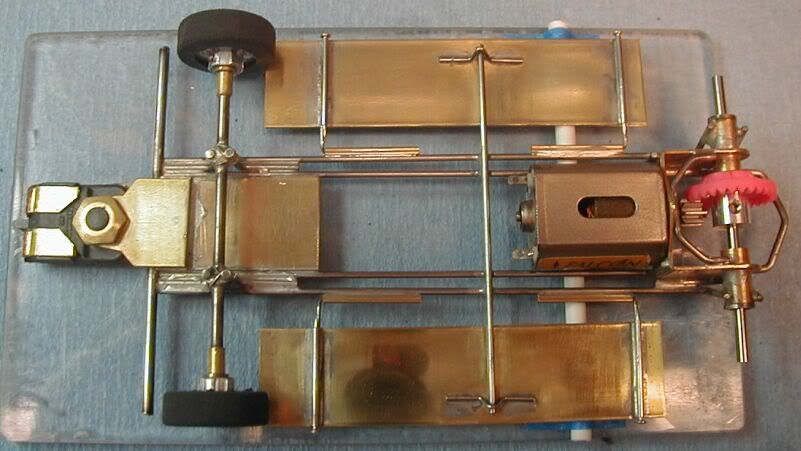

This was the first Nostalgia Can-Am frame I built, in May of 2006. It carries Serial #S-016. Rails were two of .055", two of .047", so it was quite flexible and light. The bar across the front was 3/32" wire, which meant that I had to space up the guide tongue quite far and then space down the guide again, but it did protect the front wheels.
For a body, I used the MAC Lola T160:

I sold this car to Craig Williamson, who still has it, and I restored it for the D3 Fifth Anniversary event. Unfortunately I did not get to race the car that day, but Craig got a nice clean straight car back for his collection!
S-016 was followed by a number of frames that showed minor variations of pans and bumpers, all of which went to my first customers and friends:


These show the use of static pans up front in an attempt to add more weight to the front of the car, one of the early misconceptions I had about Retro cars. It was only lots later that I realized what TonyP and John Gorski found out earlier than I did - these cars need weight at the rear. Also, in the third of the cars shown, I made the move to turn the hinges around so that that tubes were located on areas of the main rails that are already soldered to other sections of the frame. I felt that this helped to keep the rail flexibility more predictable by not soldering the hinge onto a section of rail that would flex.
The other significant iterations of this design were to add full-length pans, sometimes to use a combination of steel and brass rails, one fast but fragile car with all brass rails, and lastly to add a flexing plumber rail for mounting the pan hinges. I will have to find a photo of this last version, there is probably one in one of Keith Tanaka's wonderful race reports.
Late in 2006, the Nostalgia Can-Am group started running on the BPR king track for the first time, and I decided that a new design was needed, something that could be built light and geared to the roof for speed. Since it was going to be light, I figured it needed to be quite flexible to get some grip, so I designed this:
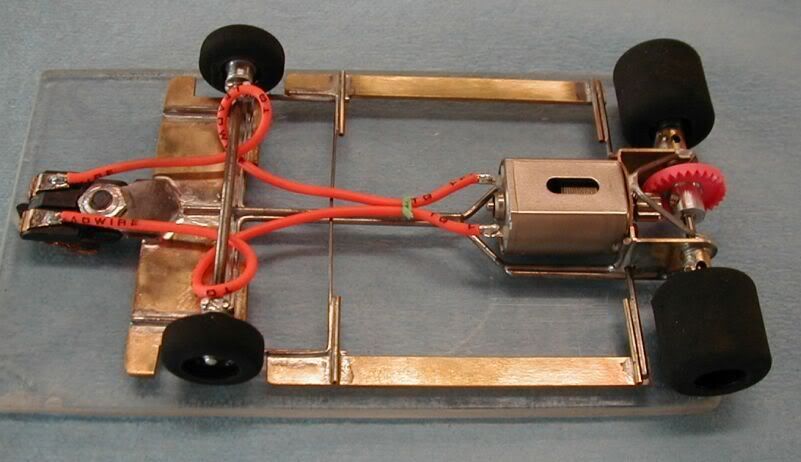

That's a lot of wire bending, it took me some time to get it right, but it was worth it. This design worked real well, and with some mods, it worked for a number of other tracks too, notably on the East Coast. Mostly the changes were just adding a bit of weight to the rear and moving the front plate back a bit underneath the front axle:

Like all of us, I guess, I read every race report from every Retro race and pore over the pictures of the frames. After one of the early Maryland races I saw a TonyP frame that looked super interesting, and that became the basis for the next iteration in my designs. Around the same time, Philippe was experimenting with some crazy "cowcatcher" bars on the front of a King Track car, so I combined the two:


This design featured a single .078" rail and generally light construction. It remains a good swoopy track design. The nosepiece is .062" brass, the static pans are .032" and the side bars are .062" by 1/4". The first frame featured a TonyP floating bite bar, but I quickly moved away from that when I realized how much work it was! The solid bite bar versions seem to work just fine, from all the feedback I have had. Later version of this frame have no "cowcatchers" up front as they raise the front of the car too much - remember the clearance is measured under the furthest forward point, so the major weight is lifted with a design like this. I went to a single straight .055" bar just to tie it all together up front.
More later!