If you are not interested in reading the long-winded narrative, cursor down for images of my NASCAR entries!
Gearing Up for Big NASCAR at Pelican Park
My visit to Pelican Park on June 18, 2025, reignited my competitive spark. The racing was fierce, and the level of talent on display was exactly what I’ve come to expect from the seasoned veterans who call this track home. These racers bring decades of experience in building, tuning, and competing—and it shows. Racing against them on their home turf is always a rewarding challenge.
With that fire lit, I’ve started prepping for my next trip to Pelican Park—this time, to compete in the Big NASCAR class.
Big NASCAR – At a Glance
Class Overview:
- Bodies: 1/24 or 1/25 scale NASCAR (1980–present)
- Motors: Supers only
- Chassis: Custom brass and wire, in-line configuration
There are some technical rules around rocker panel modifications, depending on the stock height of the wheel openings. For my first Big NASCAR entry, I’m keeping it simple: no body modifications for now.
Setting a Performance Benchmark
Based on previous results, Big NASCAR cars at Pelican Park tend to run about 0.15 seconds per lap faster than Vintage Trans-Am entries. In my most recent Trans-Am race there, my Firebird T/A was within 0.005 to 0.1 seconds of the front-runners—solid, but not quite top tier.
To set a performance baseline, I ran that same Firebird on my home track, Electron Raceway. Its best lap time became the benchmark for evaluating my NASCAR builds. If I could get my NASCAR entries to run at least 0.2 seconds per lap faster than the Firebird, I’d consider them on pace to be competitive at Pelican Park.
Tuning a Contender: My Three Options
Right now, I’m testing three possible builds for the race:
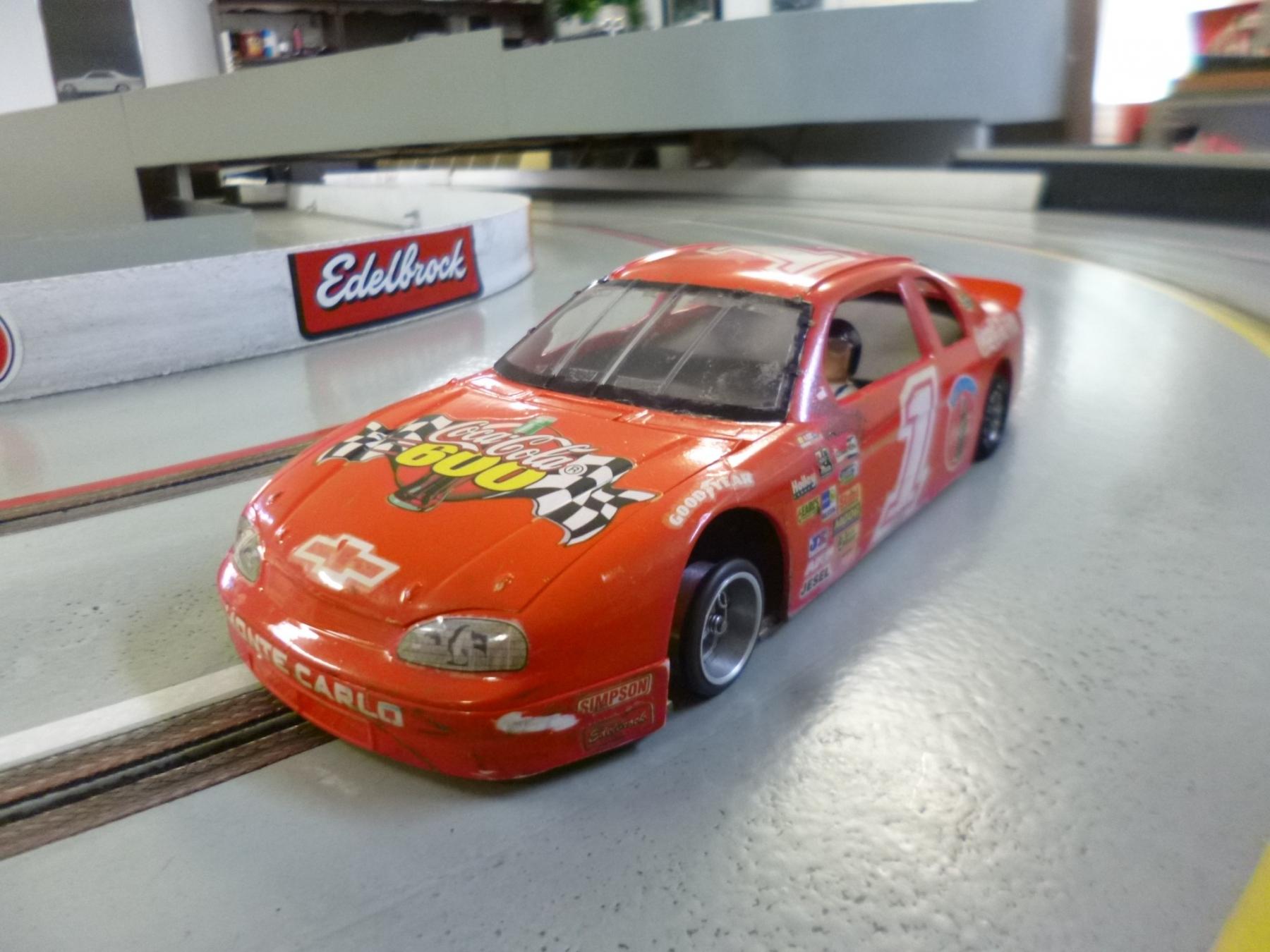
- Wide NASCAR chassis with a 1/24 Revell-Monogram #1 Coca-Cola 600 Monte Carlo (Kit #85-2550)
- Narrow NASCAR chassis with a 1/24 Monogram 1985/86 Ford Thunderbird body
- Sports car chassis with a 1/25 AMT 1993 Ford Thunderbird
(Editor’s Note: Ultimately, I set the sports car chassis aside for now—though it may return in as an option in the future.)
I’ve also got a stash of both older and newer Parma Super motors, most with minimal or no track time. Choosing the right motor will be crucial to fielding a competitive car.
Test Results: Chevy vs. Ford
After testing and tuning two slot cars, here’s what I found:
- Both cars were nearly 0.2 seconds quicker per lap than my Trans-Am entry at Pelican Park.
- The Ford was slightly slower than the Chevy but easier to drive. That makes the final decision a toss-up—it’ll depend on how they feel during practice on race night.
- Both builds seem competitive enough to hold their own in the Big NASCAR field.
As for rocker panel modifications (which can lower the center of gravity), I’ve decided to discuss the rule interpretation with the race director before making changes. If there’s time after inspection, I’ll make the modifications trackside. If not, I’ll run the car “as-is” and make any updates after the race.
Cursor down for images of both potential entries
Final Thoughts
I’m looking forward to another exciting night at Pelican Park, rubbing fenders with some of the best slot car racers around. Stay tuned—I’ll post race results.
Editor’s Note: Even though my entry might be competitive, the nut behind the wheel may not!