


My question is in regard to the rear ends of Retro Can-Am and Coupe cars. Some chassis have the bearings inserted directly into the motor bracket while some use tubes to move the bearings our farther. What is the reasoning behind the two schools of thought? It seems like the tubes would allow for a wider stance, but would be heavier and possibly more fragile? Under what circumstances would you choose one over the other?

Question for the chassis builders
Started by
Gil Aubin
, Aug 09 2026 11:18 PM
10 replies to this topic
#1

Gil Aubin
-
- Full Member
-

- 392 posts Joined: 17-July 08
On The Lead Lap
- Gender:Male
- Location:C and C Raceway
Posted 09 August 2026 - 11:18 PM
aka Jon's Dad
#2
Pablo
-

- Administrator
-
- 18,591 posts Joined: 20-February 06
Builder
- Gender:Male
- Location:Cleveland, Tennessee
Posted 10 August 2026 - 06:01 AM
Both methods have pros and cons.
If I was using a wide bracket (1" or more) for a Can Am or Coupe I'd be inclined to use the bearings direct in the bracket.
You may have to use more axle spacers to make the wheels wide enough.
With a narrower bracket for an F1 I may use tubes and bend the wires into uprights to support them.
Also this may leave more room for the sides of the body/wheels relationship.
- Gil Aubin and NSwanberg like this
Paul Wolcott
#3
slotcarone
-

- IRRA National Director
-
- 4,205 posts Joined: 23-January 07
Posting Leader
- Gender:Male
- Location:Dutchess County, NY
Posted 10 August 2026 - 06:09 AM
I prefer the bearings directly in the bracket as this eliminates the possibility of the axle tubes getting out of alignment in the inevitable rear end shunt. On many chassis where the bracket was designed for axle tubes I make it just long enough for the bracket brace to support it. Of course there is the issue of axle flex while cornering. Does the width/position of the bearings make a difference? 
- Gil Aubin and NSwanberg like this
Mike Katz
Scratchbuilts forever!!
#4
Mike Patterson
-

- Subscriber
-
- 2,688 posts Joined: 14-October 07
Village Luddite
- Gender:Male
- Location:Zanesville, OH
Posted 10 August 2026 - 08:51 AM
Personal preference. I always liked to keep the bearings as close to the wheels as possible, to eliminate any chance of axle wobble, especially with the cheap bearings I was using.
FWIW, I never bent a rear axle tube, and I used to crash a LOT! 
- Gil Aubin likes this
It's weird being the same age as Old People.
#5
slotcarone
-
- IRRA National Director
-
- 4,205 posts Joined: 23-January 07
Posting Leader
- Gender:Male
- Location:Dutchess County, NY
Posted 10 August 2026 - 09:30 AM
FWIW, I never bent a rear axle tube, and I used to crash a LOT!
The tube does not bend. They just get out of line. I bet if you check them they are!
Mike Katz
Scratchbuilts forever!!
#6
Dave Crevie
-

- Full Member
-
- 5,151 posts Joined: 16-February 09
Grand Champion Poster
Posted 10 August 2026 - 10:54 AM
I have never had a rear tube bent. Not even when I raced the F1 class at Sano, and I was rear ended on the front straight. The car flew off and hit the computer stand rear end first. The HSS drill bank was broken, the bearing destroyed, and all four of the rails bent. But the tube was still perfectly straight. I do use thicker wall tubing for rear axles, though.
By the way, Mike Swiss's narrow bracket also came out unscathed.
#7
Dominator
-

- IRRA National Director
-
- 3,153 posts Joined: 19-September 07
Posting Leader
- Gender:Male
Posted 10 August 2026 - 03:24 PM
Spacing of the bearings can also effect bite.
I personally prefer using the 1" brackets with bearings instead of the axle tube.
Early in Retro racing there were some builders who ran an extra pair ball bearings on the inner side of the axle tube for more support.
- SlowBeas, Gil Aubin and NSwanberg like this
A motor is only as fast as the chassis it's in.
Dominic Luongo
Like Dominator Custom Chassis on Facebook
NERR photos from 2012-April 2016
NERR photos from 2016 to now
#8
Bill Seitz
-

- Subscriber
-
- 725 posts Joined: 20-February 21
always in last place
- Gender:Male
- Location:Tucson, AZ
Posted 10 August 2026 - 08:18 PM
I typically prefer things as simple as I can make them, so usually I put the axle bearings directly into the bracket. I had some vintage brackets made for 1/4" OD bearings and found some K&S thick-wall brass tube that was 1/4" OD and 3/16" ID, perfect as a reducer for 3/32" axle bearings. I decided to cut the thick-walled tube into axle tubes that extended the bearings out about 1/4" each side for a rear bearing width of ~1.5" vs a bracket width of ~1". Keeping those axle tubes aligned while building was a trick in itself. That and the extra bracing to keep this all aligned added weight, and adding weight on the rear of a chassis is generally not the right thing to do. After the extra work, there was no performance improvement, so I've returned to putting my axle bearings directly in the bracket.
- MSwiss, Gil Aubin and NSwanberg like this
#9
j-slot
-

- Full Member
-
- 122 posts Joined: 02-January 11
Mid-Pack Racer
- Gender:Male
- Location:Tokyo
Posted 12 August 2026 - 03:18 AM
The bearing mounting position is essentially the point where torsional forces from the tires are transmitted into the chassis.
These forces act at the joint between the motor bracket (including the axle tube) and the main rails, with the fulcrum located where the main rails connect to the front section of the chassis.
Since I don’t have a formal background in mechanics or physics, I determine the position, diameter, and number of the main rails—as well as the spacing between the bearings—based largely on experience and intuition.
I've tried several methods, but unless the design requires it, I usually mount the bearings directly onto a 1-inch-wide motor bracket.
- Cheater, MSwiss, Gil Aubin and 1 other like this
#10
Mike Patterson
-
- Subscriber
-
- 2,688 posts Joined: 14-October 07
Village Luddite
- Gender:Male
- Location:Zanesville, OH
Posted 12 August 2026 - 09:37 AM
The tube does not bend. They just get out of line. I bet if you check them they are!
And I'll bet they're not.
I have managed to bend a motor bracket, though.
It's weird being the same age as Old People.
#11
MSwiss
-

- Subscriber
-
- 26,221 posts Joined: 16-April 06
Grand Champion Poster
- Gender:Male
Posted 12 August 2026 - 12:01 PM
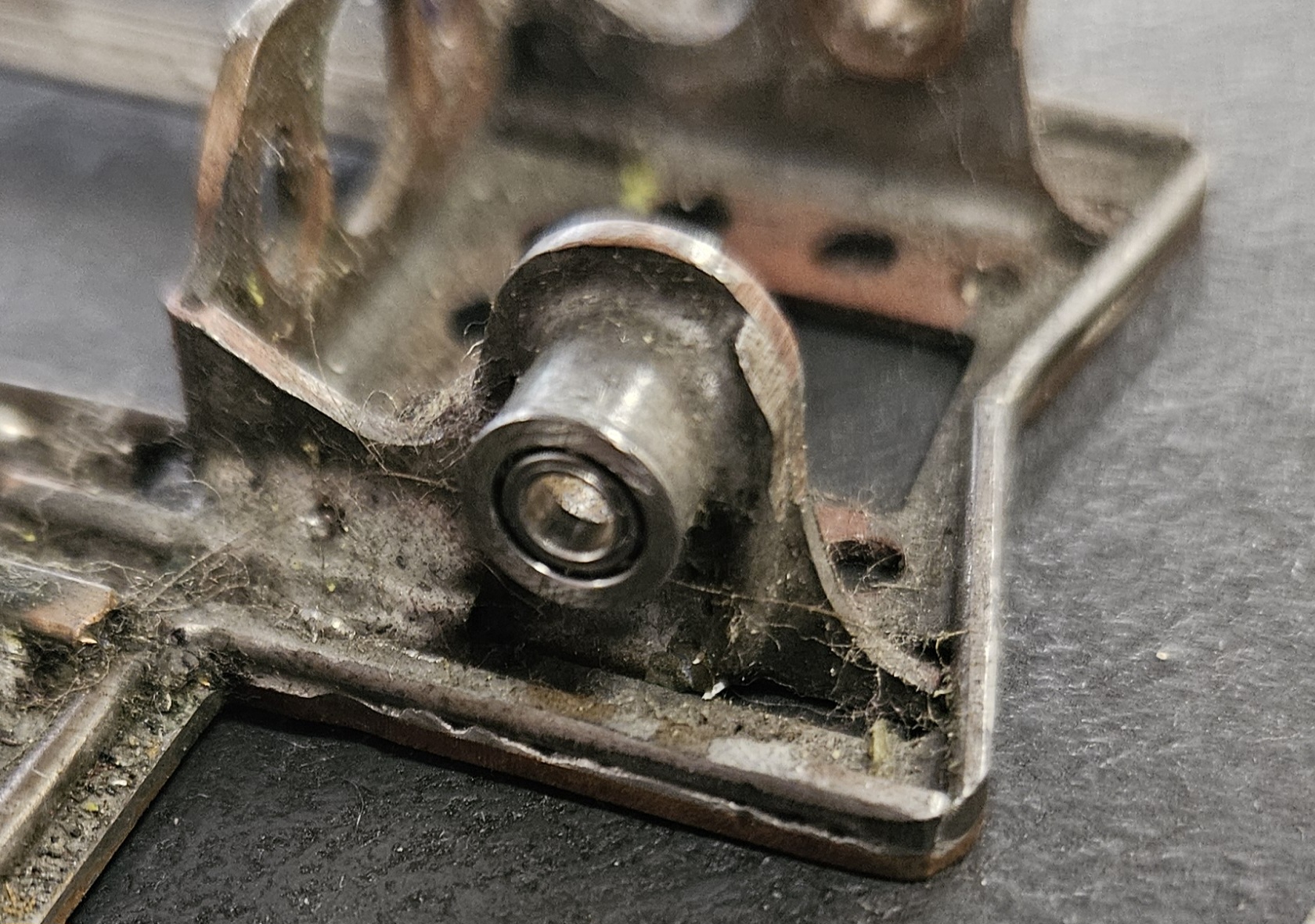
Here's a shot of the rear of my successful Z rail chassis from about 2010.
It had TQ's, wins, and podiums at the Sano, on both the King and Flat track, with a couple different local racers.
Along with it having a ton of laps on it, I finished 4th with it at the 60 car R4/4, 3 or 4 laps back from the winner, despite getting ridered into Tom Thumb's notoriously hard
American Raceway's 90 wall.
It survived arguably slot racing toughest hit outside of getting banked at TT at a higher speed.
I just checked it and an axle drops right through the BB's.
While another piece of wire supporting the end of the tube wouldn't hurt, the brace alongside the bracket and behind the tube proved to be enough. And that looks like a pretty good solder joint. Lol
An aside from that race, with TT's tight pit space and being preoccupied with repairing the body, I wasn't able to go over the car. The next heat the car was just a tad loose and the car made gear noise in the bank every lap. I survived the heat, dropping only a lap, tops.
Between heats I discovered one tire was totally loose on the axle and could move side to side a bit, but it never came off because of the inner notch of the flat. Anyway, I tightened it up and car went back to 100%.
After witnessing all the big hits my Z rail Can Am and F1 car took and survived undamaged, I'm 98% convinced
the Z-rail design absorbs some of the hit.
- Gil Aubin, NSwanberg and Alchemist like this
Mike Swiss
Inventor of the Low CG guide flag 4/20/18
Former IRRA® Components Committee Chairman
Five-time USRA National Champion (two G7, one G27, two G7 Senior)
Two-time G7 World Champion (1988, 1990), eight G7 main appearances
Eight-time G7 King track single lap world record holder
17B West Ogden Ave., Westmont, IL 60559, (708) 203-8003, mikeswiss86@hotmail.com (also my PayPal address)
Note: Send all USPS packages and mail to: 692 Citadel Drive, Westmont, Illinois 60559




