My Brethren,
Thank you for the kinds words and inspiration!
Hi Dave,
That is a very cool chassis, and for me, it's such in inspiration in design! How did you acquire that awesome material - legally? LOL!
Bill from NH said:
Ernie, you did a nice job fabricating this chassis & it's parts. It looks to be somewhat indestructible. It also might be a good chassis for rental car use too. I can visualize you making all sorts of other chassis designs using the same techniques. Maybe both 1/24 & 1/32. What did you use to mount/attach the aluminum pieces to the phenolic? Did you use some sort of epoxy, or other adhesive? Let us know how this one drives.
Hi Bill,
You are correct in your observation that the phenolic is virtually indestructible. I'd like to share a story in regards to it's "durability".
Approximately over 10 years ago, when I was starting to get back into 1:24 slot car, I had purchased a few different brands of angle motor stamped steel slot car chassis, along with low cost motors and a Parma controller.
Trying to redevelop my "hand-eye coordination) while relearning to drive, and coming to the realization, that when you crash, the chassis will bend, and beyond my skill level to repair!
Having worked with composites and alloys as well as custom painting, fabrication and body repair, (I was a design engineer in automotive restoring of vintage race cars/mods to current race car, and other high dollar collectable cars) I figured I would make an attempt to fabricate my own chassis.
Having discovered "Slotblog" back then, it was a thrill to view the many scratchbuilt chassis projects of the brethren here, and still is my source of inspiration.
Now, back to how indestructible, phenolic composite can be.
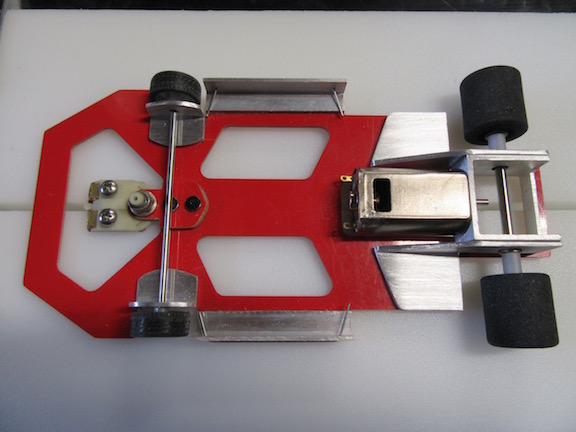
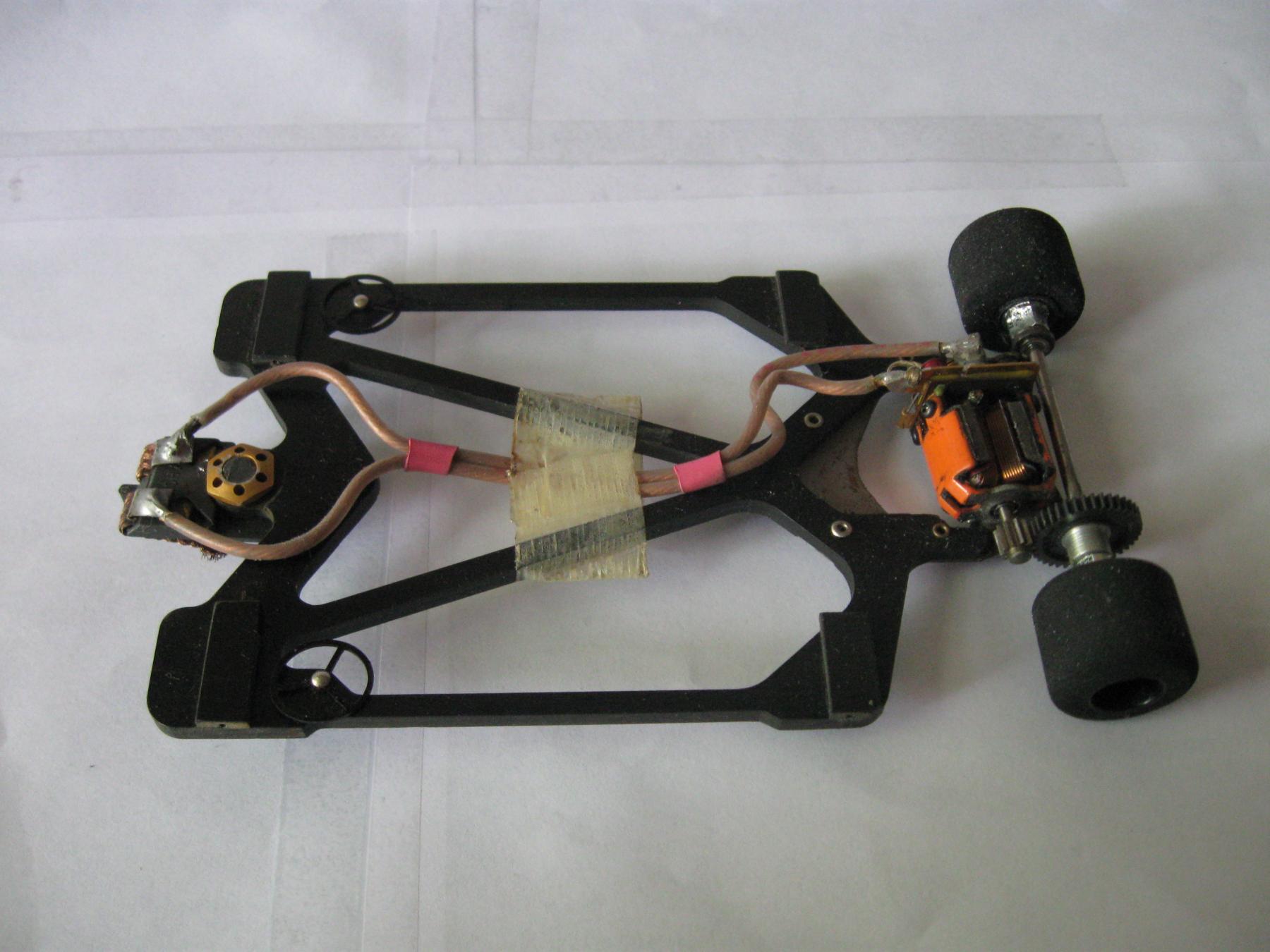
My first anglewinder prototype consisted of .032" thick G10 phenolic, and since I had a few chassis's that, to me, were no longer usable, I cut off the rear motor/axle mount and stuck it on my chassis design.
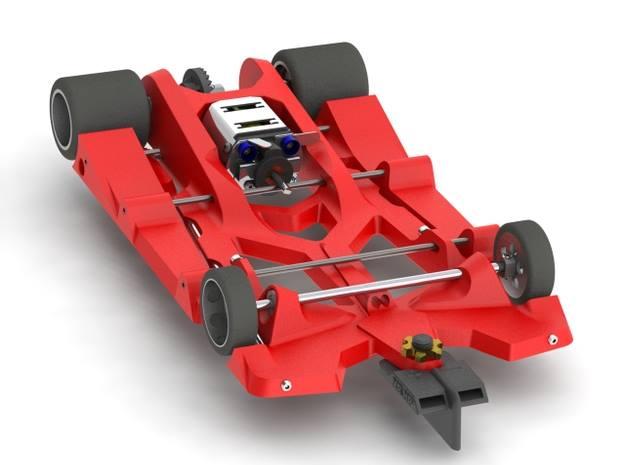
Here are photos of my initial prototype. To this day, every thing is hand cut and filed to shape. I would like to acquire some equipment to make it easier but I find it satisfying to fabricate "old school".


The motor was built by our own "Sir John Havlicek", and I must say that I'm privileged to have a handful of custom built motors from him.
with body mounted:
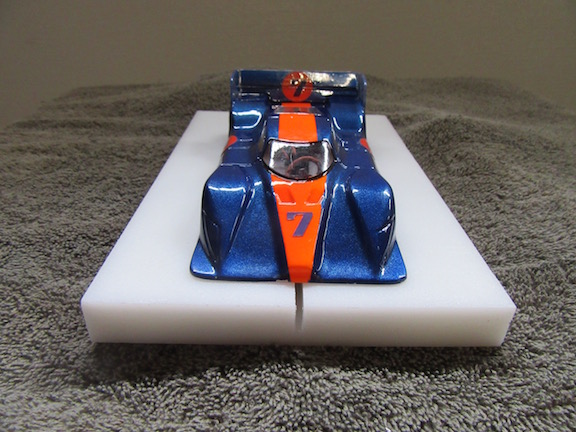

On my first test, I wanted to see how it would survive a crash.
I live in Vallejo, CA - and Eddie's Slot Cars has the Blue King Track.
I ran full throttle on different parts of the track to intentionally crash in a variety of ways.
The most severe crash was at the end of the straightaway.
The other racers initially scoffed at my design and when everyone heard the big crash - someone sheepishly yelled "back to the drawing board" amidst a bunch of laughter.
Well, the only item that had come loose was a body wire clip that I just clipped back on and placed it back onto the track to keep testing.
I had quite a few inquiries after that incident, because they figured with such a big crash, the car would be totaled.
I was inspired to continue developing my composite chassis.
I would like to share the remaining prototypes of my anglewinder composite chassis's and my own custom box I keep them in.
Here is my box that I made from aluminum/polyethylene composite sandwich board and vinyl wrapped.
The cars on the shelves are all the anglewinder prototypes running Sir John Havlicek's motors.

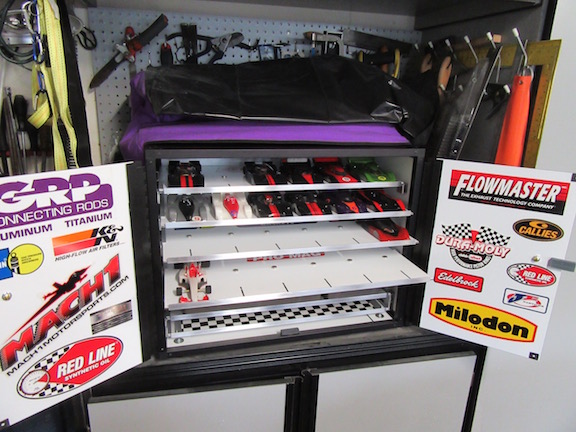
I made the handles from RC Car wheels and tires I had laying around and even fabricated cross-drilled steel rotors - made from steel washers.


This particular chassis, on the Blue King, with me driving, started out on the first lap in the mid 8 seconds.
After many more laps (after the many crashes LOL), and getting acclimated to driving it, eventually dropped down to my best of low 6 second laps.
A couple of fellow racers asked if they could drive it and I shared it with them.
One racer, after only a few laps, immediately was running mid 5 seconds laps.
The other racer was able to hit consistently 5.0-5.1 second laps, after having rubbed some traction compound on my tires and placed some weight on the front of the chassis.
After a little discussion, it was determined that my Parma controller was the problem because it could not handle the power from Sir John's motor.
I felt that it wasn't just the controller I was using - I just can't drive - hahaha!
The two racers had the more sophisticated controllers - they might have been Third Eye controllers or something equivalent.